
A practical 2026 guide to public and private maternity care, childbirth prices, healthcare coverage and additional expenses
Updated November 2026
If you are pregnant and living in Hungary, or considering giving birth in Budapest, one of your first practical questions may be: how much will childbirth actually cost?
The answer depends mainly on your healthcare entitlement and whether you choose a public hospital or private maternity care.
In short: Childbirth in a Hungarian public hospital is generally covered if you are entitled to national health insurance. Private maternity packages in Budapest currently start at approximately HUF 900,000, while more comprehensive packages can cost over HUF 3 million. Prenatal care, optional services and unexpected medical expenses may increase the total considerably.
For international families, the situation can be more complicated. Having a Hungarian address or a European Health Insurance Card does not necessarily mean that a planned birth in Hungary will be covered.
This guide explains the main costs, the differences between public and private care, and the questions worth asking before making your decision.
1. How much does childbirth cost in Hungary?
There are two main routes: publicly funded maternity care and privately paid childbirth services.
In the public system, eligible women generally do not pay for standard maternity care or medically necessary hospital delivery. In the private sector, families pay for a delivery package, sometimes together with separate pregnancy care, selected professionals and accommodation.
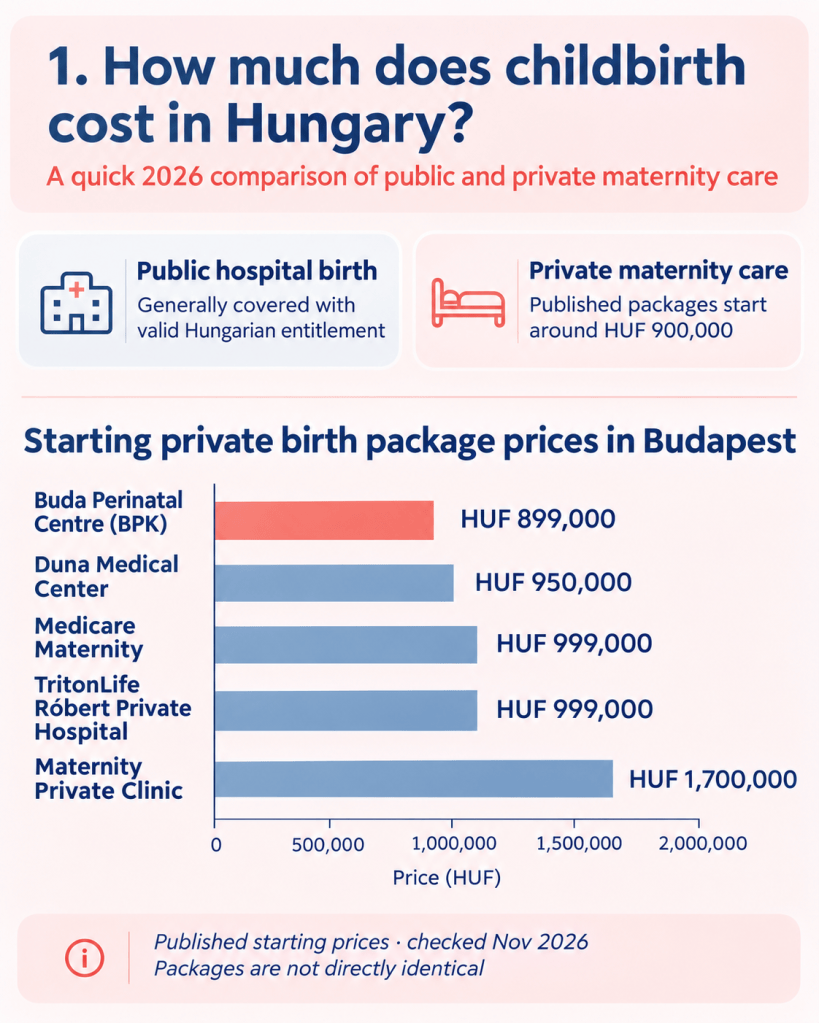
Private childbirth prices in Budapest: 2026 comparison
The following table compares published starting prices at five maternity providers.
| Provider | Starting birth package |
|---|---|
| Buda Perinatal Centre (BPK) | HUF 899,000 |
| Duna Medical Center | HUF 950,000 |
| Medicare Maternity | HUF 999,000 |
| TritonLife Róbert Private Hospital | HUF 999,000 |
| Maternity Private Clinic | HUF 1,700,000 |
Published prices checked in November 2026. These are starting package prices, not necessarily the final cost of pregnancy and childbirth.
The packages are not identical. They vary in the medical professionals involved, prenatal examinations, accommodation, pain relief, neonatal services and postnatal support.
There is also a difference in the type of setting: Buda Perinatal Centre provides planned out-of-hospital childbirth care, while the other providers listed here offer hospital-based delivery.
Understanding what is included in each package is therefore just as important as comparing the headline prices.
2. Public maternity care: when is childbirth free?
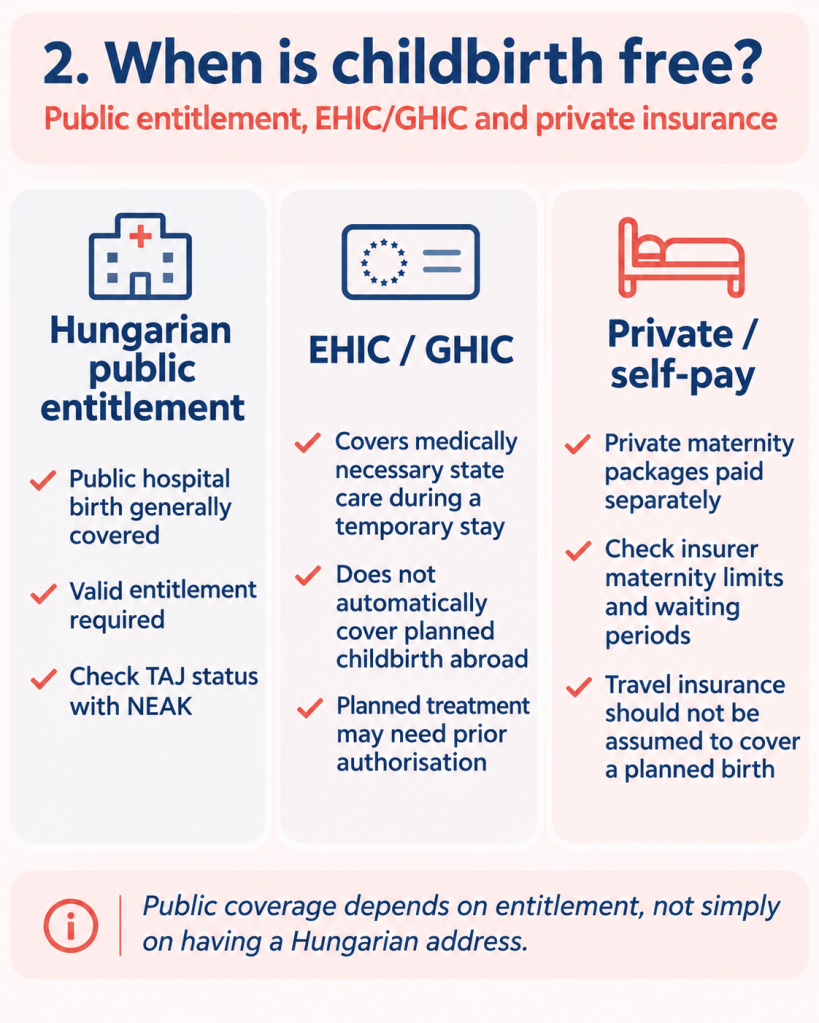
Childbirth in a public hospital is generally covered for women who are entitled to Hungarian national health insurance.
This includes medically necessary antenatal examinations, delivery, caesarean sections when required, and standard hospital care for mother and baby.
Public maternity hospitals are staffed by obstetricians, midwives and neonatal professionals. Births are generally attended by the team on duty. Facilities, accommodation and individual hospital practices vary, so it is worth asking about your options before choosing where to give birth.
Hungarian health insurance and the TAJ number
The Hungarian social security identification number is called a TAJ number (Társadalombiztosítási Azonosító Jel).
If you work in Hungary or are otherwise insured through the Hungarian system, you will usually be entitled to publicly funded maternity care. However, holding a TAJ card does not automatically prove that your insurance entitlement is currently valid.
If you are uncertain about your status, check with the Hungarian National Health Insurance Fund (NEAK).
What if you are an EU citizen temporarily staying in Hungary?
A valid European Health Insurance Card (EHIC) provides access to medically necessary state healthcare during a temporary stay, including pregnancy-related examinations and childbirth when care becomes necessary during the visit.
However, if you are travelling to Hungary specifically to give birth, an EHIC alone does not automatically cover this planned treatment. You may need prior authorisation, usually through an S2 arrangement.
Check with your home country’s insurer before making any plans.
What if you are travelling from the United Kingdom?
A UK Global Health Insurance Card (GHIC) or eligible EHIC can provide access to medically necessary state healthcare during temporary visits.
For a planned birth in Hungary, however, the NHS has a separate application process. You should contact the NHS Business Services Authority, complete the appropriate Giving Birth Abroad application, and confirm which costs may be covered before travelling.
Official NHS guidance on giving birth outside the UK
What if you have private health insurance?
International health insurance may cover some or all of the cost of private maternity care, but policies differ considerably.
Check maternity waiting periods, annual or lifetime limits, cover for caesarean sections, premature birth and neonatal treatment, and whether the insurer can pay the hospital directly.
Ordinary travel insurance should not be assumed to cover a planned birth abroad.
If you are not entitled to Hungarian public healthcare or an applicable international arrangement, you should expect to pay for maternity services yourself and request a written quotation.
3. Private childbirth in Budapest: what do the packages include?
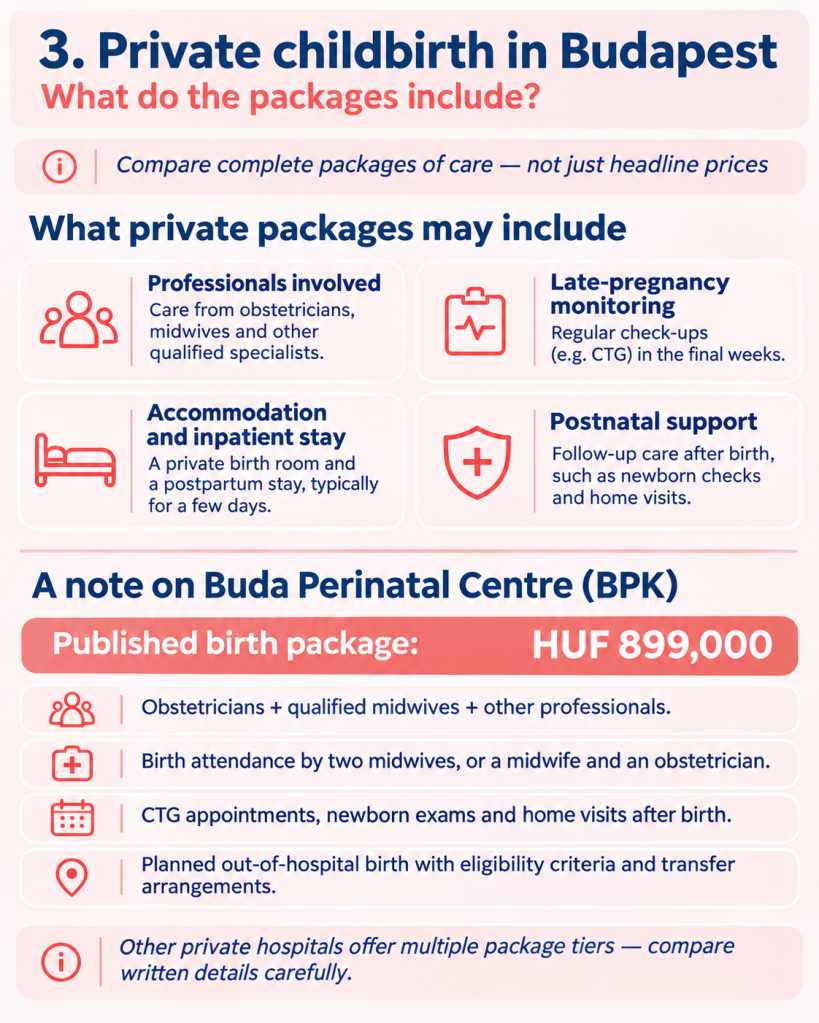
Private maternity providers offer different combinations of obstetric and midwifery care, examinations, accommodation and postnatal services.
Some packages focus primarily on the birth and hospital stay, while others include more extensive late-pregnancy monitoring, individual professional support or additional services after delivery.
A higher price does not necessarily mean that every service you might want is included. Conversely, a package with a lower starting price may provide services that another provider charges for separately.
The most useful comparison is therefore between the complete packages of care, rather than their advertised prices alone.
A note on Buda Perinatal Centre (BPK)
The Buda Perinatal Centre (Budai Perinatális Központ) is worth explaining separately because its approach and service structure differ from those of conventional private maternity hospitals.
BPK is a multidisciplinary perinatal centre where obstetrician-gynaecologists, qualified midwives and other professionals provide services throughout pregnancy, childbirth and the postnatal period. Alongside maternity care, it offers ultrasound examinations, childbirth preparation, perinatal counselling, breastfeeding support and postnatal consultations.
Its published HUF 899,000 birth package includes attendance by two midwives, or a midwife and an obstetrician-gynaecologist, together with late-pregnancy CTG appointments, newborn examinations and home visits on the first and third days after birth.
Comprehensive antenatal care and childbirth preparation packages are also available separately. Some of BPK’s services can be used by families planning to give birth elsewhere.
BPK provides planned out-of-hospital births under Hungarian regulations, with specific medical eligibility requirements and arrangements for hospital transfer if needed. Families considering this option should discuss these details directly with the professional team.
Comparing the other private options
The four private hospitals in the table offer several levels of delivery packages, generally differentiated by their included examinations, choice of professionals, accommodation and additional services.
For example, Medicare’s published packages range from HUF 999,000 to HUF 1,499,000, while TritonLife’s range from HUF 999,000 to HUF 1,649,000.
Duna Medical Center offers packages from HUF 950,000 to HUF 2,090,000, and Maternity Private Clinic publishes standard and premium options ranging from HUF 1,700,000 to HUF 3,400,000, with a separate package for twin births.
Each provider publishes further details about the services included. Before choosing, compare the packages in writing, particularly if you want a specific obstetrician or midwife, particular pain relief options, or accommodation for your partner.
4. What is included in the price — and what costs extra?
The advertised cost of a private birth package is often only part of the total expenditure.
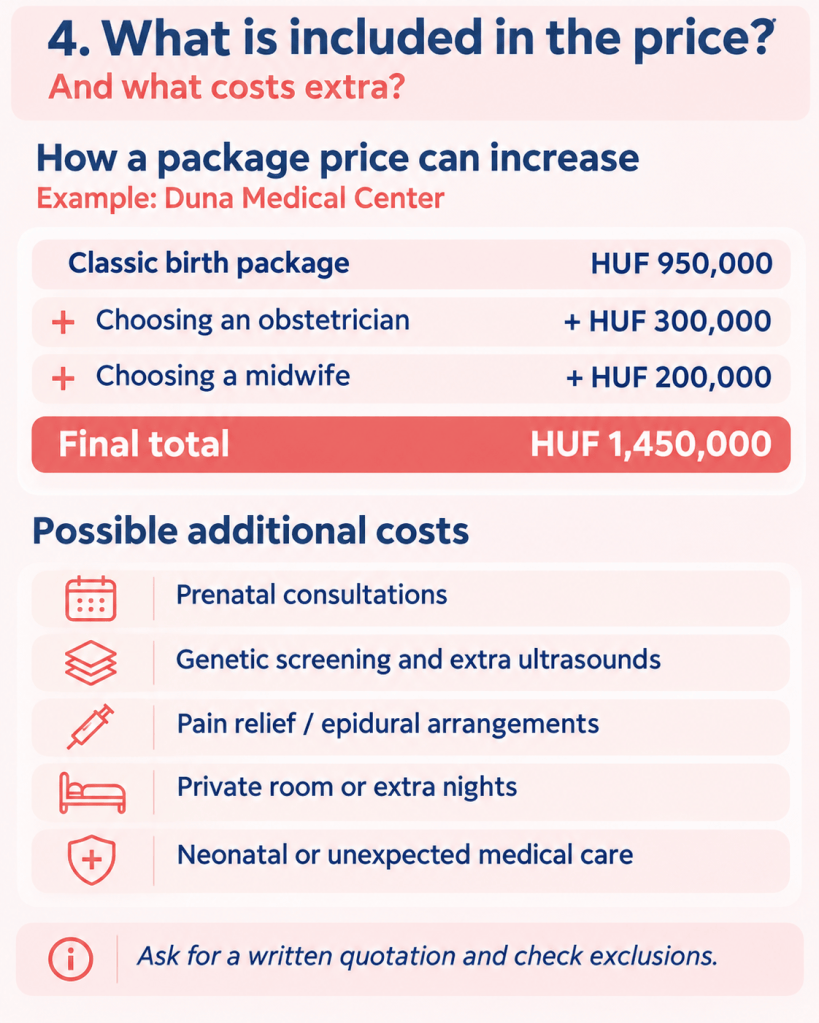
Depending on the provider, you may also pay for prenatal consultations, genetic screening, additional ultrasound examinations, choosing a particular doctor or midwife, certain forms of pain relief, private accommodation, additional hospital nights or specialised medical treatment.
An example: how a HUF 950,000 package becomes HUF 1,450,000
Duna Medical Center’s published Classic package provides a useful example:
| Service | Price |
|---|---|
| Classic birth package | HUF 950,000 |
| Choosing an obstetrician | + HUF 300,000 |
| Choosing a midwife | + HUF 200,000 |
| Total | HUF 1,450,000 |
And this is before separately charged pregnancy care or other optional expenses.
This does not mean that every family will pay these additional fees. Choosing a particular professional is optional, and other packages may include some of these services in their starting price.
The point is simply that package prices need to be interpreted carefully.
Questions to ask before signing a maternity contract
- Does the price cover both vaginal birth and caesarean section?
- Which prenatal examinations and late-pregnancy monitoring appointments are included?
- Can I choose my obstetrician and midwife, and what are the additional fees?
- Is epidural pain relief included or charged separately?
- How many hospital nights are included, and what accommodation is provided?
- What happens financially if I need additional treatment or my baby requires specialised care?
- What postnatal care and breastfeeding support are included?
- What happens if complications require transfer to another hospital?
Ask for a written quotation covering the services most relevant to your circumstances, and make sure you understand any exclusions.
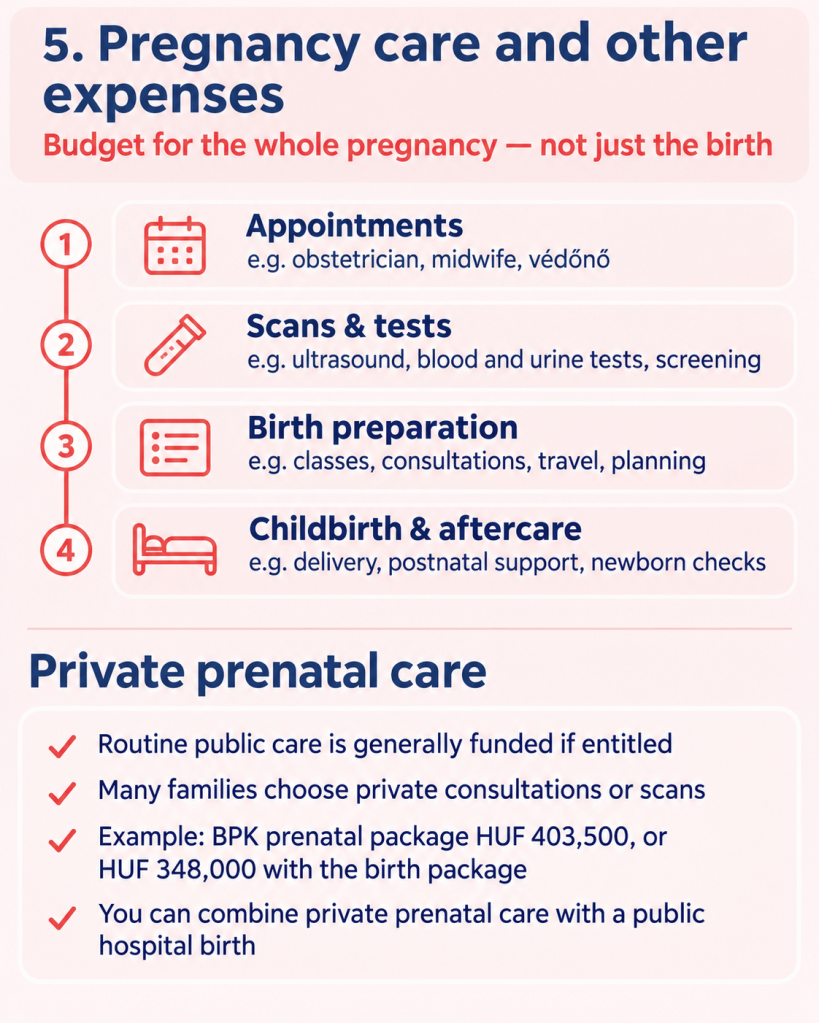
5. Pregnancy care and other expenses
The cost of childbirth is not necessarily the same as the cost of maternity care throughout pregnancy.
Hungarian antenatal care typically involves an obstetrician-gynaecologist, ultrasound examinations, blood and urine tests, screening appointments and support from a védőnő, a community maternal and child health professional.
The results are recorded in a maternity booklet, usually called the várandósgondozási kiskönyv.
If you are entitled to public healthcare, eligible routine examinations are generally funded. However, many families choose private obstetric consultations, ultrasound scans or additional screening.
Private prenatal care
Private clinics offer individual appointments as well as comprehensive antenatal packages.
For example, Buda Perinatal Centre currently publishes a prenatal care package priced at HUF 403,500, reduced to HUF 348,000 when purchased together with its birth package. Laboratory testing is charged separately.
Other providers offer different packages, often depending on how early in pregnancy care begins and which examinations are included.
You do not necessarily need to purchase private pregnancy care and a private birth package from the same provider.
Private prenatal care combined with a public hospital birth is a common arrangement for women who want additional consultations but are entitled to publicly funded delivery.
When planning your budget, consider the whole pregnancy: appointments, examinations, travel, maternity preparation, childbirth itself and support after birth.
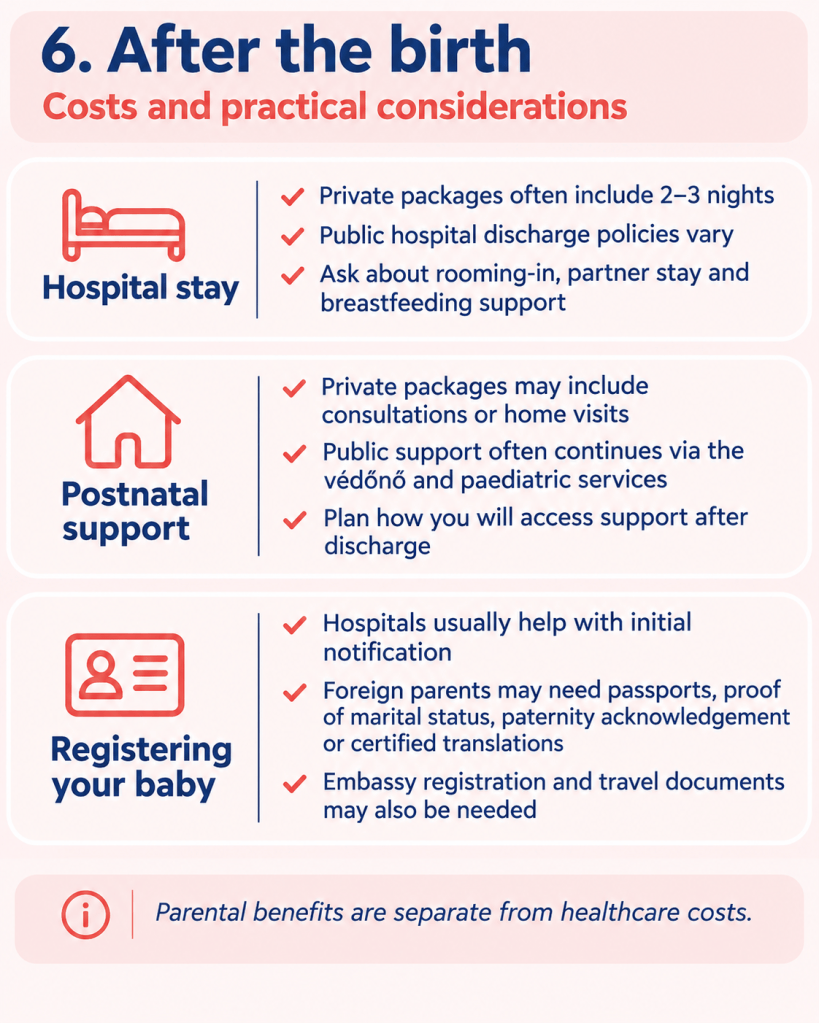
6. After the birth: costs and practical considerations
The length of your hospital stay depends on the type of delivery, the health of mother and baby, and your provider’s arrangements.
Private maternity packages commonly include around two or three nights, although additional accommodation may cost extra. Public hospitals have their own discharge policies.
It is worth discussing immediate skin-to-skin contact, breastfeeding support, rooming-in, visiting arrangements and whether your partner can stay overnight.
Postnatal care
Some private maternity packages include consultations or home visits after birth. Others concentrate mainly on inpatient care.
In the public system, families generally receive support through the védőnő and paediatric services after returning home.
If you are an international family, especially one without established local healthcare arrangements, consider how you will access postnatal support, newborn examinations and help with breastfeeding once you leave the hospital.
Registering your baby’s birth
All babies born in Hungary need to have their births registered through the Hungarian civil registration system.
Hospitals usually assist with the initial notification, but foreign parents may need additional documents, such as passports, evidence of marital status, an acknowledgement of paternity or certified translations.
You may also need to register your baby’s birth with your embassy or consulate and arrange a passport or other travel documents.
It is sensible to clarify these requirements before the birth, particularly if you do not intend to remain in Hungary afterwards.
Hungarian maternity and parental benefits, including CSED, GYED and GYES, are separate from the cost of healthcare. Eligibility depends on your employment and insurance circumstances. The Hungarian State Treasury provides official information.
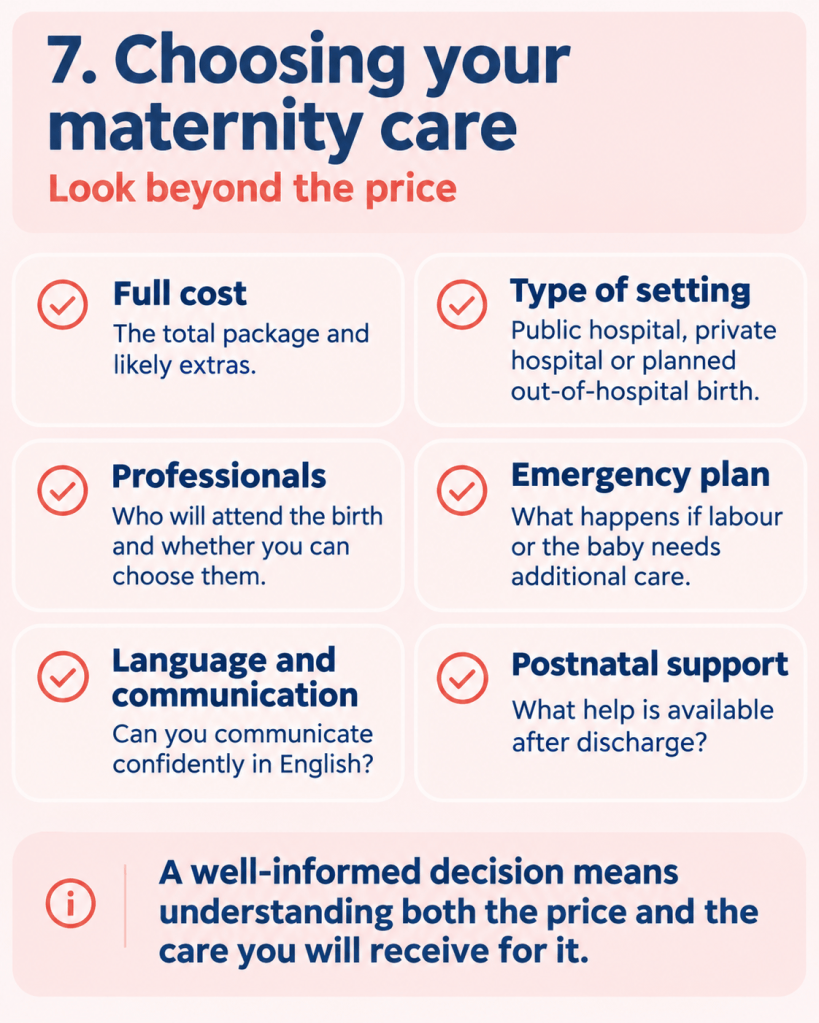
7. Choosing your maternity care: look beyond the price
The financial side of childbirth deserves careful planning, but it is only one part of the decision.
When comparing maternity care providers, consider the kind of environment you would feel comfortable in, the medical services you may need, your ability to communicate with the professionals attending the birth, and the support available afterwards.
For international families, language can be especially important. Ask whether appointments, medical information, consent forms and discharge instructions can be provided in English.
It is also worth finding out how the provider handles unexpected changes in labour, what happens if a caesarean section becomes necessary, and what arrangements exist for neonatal or emergency care.
A private hospital does not automatically guarantee a better birth experience, just as publicly funded care does not necessarily mean less personal or compassionate treatment.
A well-informed decision means understanding both the price and the care you will receive for it.
Final thoughts
So, how much does it cost to give birth in Hungary?
For women entitled to Hungarian publicly funded healthcare, standard hospital maternity care is generally covered.
For those choosing private childbirth, published delivery packages in Budapest begin at approximately HUF 900,000, with more comprehensive packages costing several million forints. Additional pregnancy care, selected professionals, accommodation and unexpected medical treatment may increase the total.
The most useful approach is to confirm your healthcare entitlement, compare complete maternity packages rather than headline prices, and make sure you understand what happens if your birth takes an unexpected course.
Good preparation is about more than financial planning. It also means knowing your options, asking questions and feeling able to participate in decisions about your own care.
About the author
Gáborjáni Réka is a women’s health and perinatal consultant, childbirth educator and creator of JógaSzülés™. She has worked with pregnant women and new mothers for more than two decades, combining childbirth education, perinatal psychology and body-centred approaches to pregnancy and birth.
Explore her childbirth preparation and pregnancy yoga resources, including online learning materials and practical guides.
Prices and information checked in November 2026. Healthcare entitlements, maternity packages and fees may change. Always confirm current arrangements directly with the relevant healthcare provider, insurer or authority.


Szólj hozzá!